


THE SHELL: A PORTAL THROUGH BRIGHTON’S ARCHITECTURE
- gnosticmystic67
- Dec 5, 2025
- 8 min read


We've walked Brighton's streets to its furthest reaches, hidden corners, excited eyes trained high, and low, seeking the stories, memories, secrets, sources for our art, and answers, from its oldest buildings. The city is an an anarchitectural wonderland beneath its run down grime chic. Its extravagantly aged exteriors covered in potential symbolic treasures. Hands on camera, sniper zoom sharp, intuition alert, ready to reveal another forgotten element of Brighton's silent language.
What will whisper loudest?
What will give a sly wink?
Of Brighton's most widespread architectural symbols we have captured and analysed the Delphin and The Garland/Cornucopia, as the first two parts of our Brighton Symbols series. For a city with its maritime history, lost ancient springs, shifting seaside, a place of rebirth for many, (and some folks have even spoken of communing with the divine) the next symbol is most apt : The Shell - also transfroming, echoing its ancint roots, into Sunrise.
More often a scallop shell - crowning a Goddess or civic pediment, hiding on a crumbling parapet; or sometimes as sunrise - a fan of illuminated rays, rising atop a Dutch gable, a proud seafont Victorian window. Layers thick painted plaster, sometimes terracotta the colour of dried blood or wet sand. So why do so many remain from their Regency/Victorian refashioning, builders scattered bountifully over all parts of the city's architecture - were they more than simple beautification? (You may even have one adorning your home or local take away - have a look.)

Across civilisations, seas, and millennia, the shell was never merely decorative. It was a vessel of power: a carrier of breath, a cradle of birth, a resonator between human beings and the unseen world. From the Bronze Age Aegean to the shores of India, from Egyptian tombs to Celtic wells, the shell was revered as an intermediary object — a threshold between worlds.
Brighton’s architecture inherits this lineage quietly but unmistakably. The façades of Regency terraces, Victorian shopfronts, late-19th-century banks, and forgotten upper-floor panels carry the same motifs used in temples, tombs, and sanctuaries. They were placed here deliberately — not as random ornament, but as symbols carrying continuity, power, memory, and intent.
Once you start seeing them, the city begins to speak.
SECTION I — THE SHELL OF EMERGENCE
Birth • Arrival • Incarnation
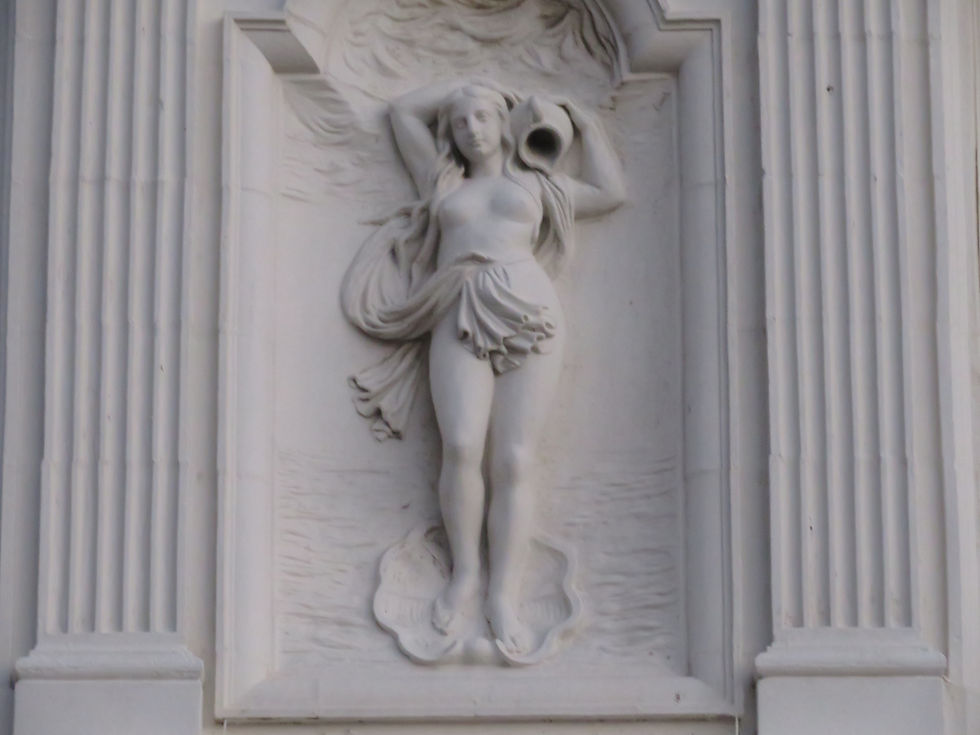
The oldest meaning of the shell is birth from the waters — a moment of emergence, arrival, incarnation. In Mesopotamian myth, life rises from the apsu (the deep); in the Aegean world, divine beings step forth on shells; in Egyptian cosmology, the primeval mound emerges from the endless sea.
The pattern is universal: water first, then form. The shell is the hinge between the two:
Water → Vessel → Birth
Brighton’s façades carry this lineage more explicitly than most cities dare. Take the West Street Venus: a figure rising from the surf, feet poised on a scallop shell, framed by architectural columns that mimic temple gates. This is not Victorian whimsy — it is a deliberate invocation of the moment of emergence, a symbolic re-enactment of divine arrival through the medium of stone and plaster. The scallop is the emblem of arrival, of first breath, of consciousness stepping into the visible world. A direct invocation of ancient symbolism.
Elsewhere across the city, simplified scallops appear above doorways, windows, arches, and pediments. Each marks a threshold — the point where something moves from inner to outer, private to public, unseen to seen.

The builders may not have spoken the language of myth, but they were fluent in its symbols.
They may have called it ornamentation.
But the symbol remembers what it is.
SECTION II — THE SHELL AS CONDUIT OF COMMUNICATION
Voice • Sound • Divine Transmission
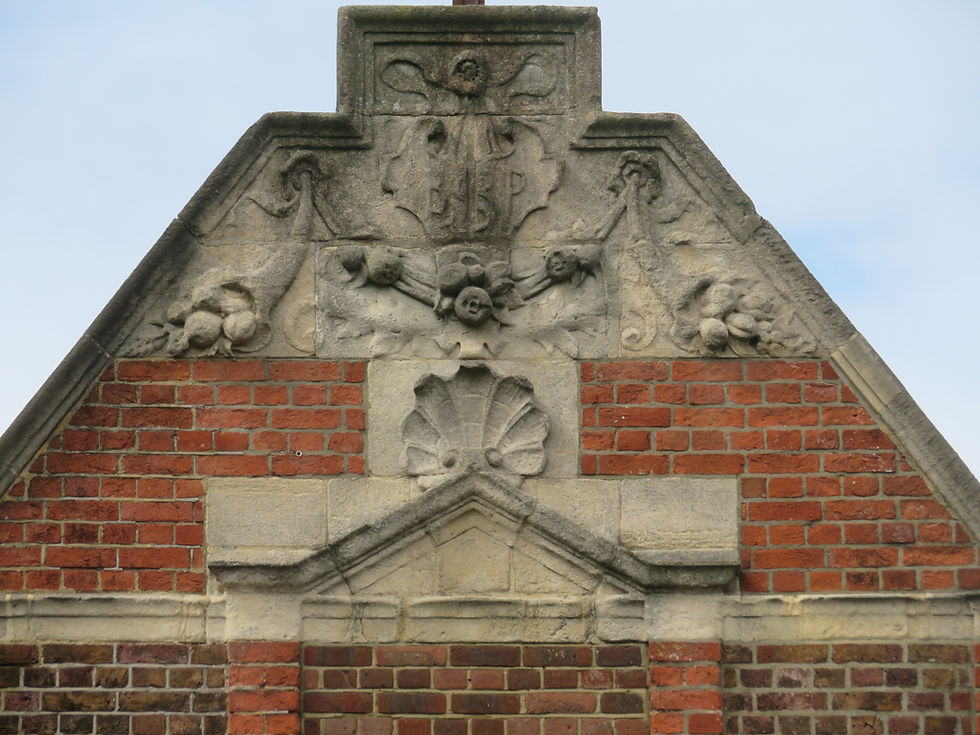
Across ancient cultures, shells were not passive symbols — they were instruments.
The conch, especially, was used as:
a trumpet to announce spiritual presence,
a signal of power or ritual gathering,
a calling device for gods, kings, travellers, and spirits.
In India and Tibet, the conch still signifies the broadcasting of sacred truth.In Greece and Rome, Triton’s horn summons the worlds. In shamanic traditions, shells were used to communicate with ancestors or deities.

What does this mean for Brighton’s architecture?
Where shells cluster above commercial entrances, civic buildings, or grand townhouses, they often signify a broadcasting point — a place intended to “speak” outward. Even the quiet oval shells on terrace houses carry the residue of resonance: they mark places designed to be heard in some capacity.
Through Victorian hands, this ancient meaning was flattened into “ornament.” But the symbol doesn’t forget what it once meant.
SECTION III — THE SHELL AS PROTECTOR AND THRESHOLD GUARDIAN
Boundary • Safe Passage • Energetic Shield

The shell is a natural fortress: a home that is also armour.
Ancient builders understood this and used shells as protective seals, especially over thresholds — doorways, gates, and crossings where the boundary between inner and outer is vulnerable.
Brighton echoes this older instinct.
Shells frequently appear:
above windows (the “eye” of the house),
over entrances,
on lintels and projecting pediments,
and clustered along entire façades in repeating protective bands.

The placement is intentional: the shell occupies the exact architectural points where “energetic interference” or unwanted influence is symbolically repelled.
It is both invitation and shield. It says: “You may pass — but you must pass clean.” But to whom is it being said - and do they know?
SECTION IV — THE SHELL AS VESSEL OF TRANSITION
Death • Passage • Rebirth

In Egypt, shells were placed in tombs to assist soul's transition. In early Christian iconography, the scallop becomes the symbol of pilgrimage — the path between lives. In shamanic contexts, shells were used to guide the dying through the liminal between worlds.
So when Brighton’s shell motifs appear on older civic buildings, banks, converted churches, and Victorian institutions, they often mark sites associated with movement from one phase to another:
transitions of identity,
transitions of wealth,
transitions of social role,
transitions of life stage.

The Victorians did not revive these symbols accidentally. They were obsessed with the ancient world and classical civilisation. They borrowed these motifs specifically because shells signified safe passage.
Brighton, being a liminal city by nature — between land and sea, between old town and new town, between the living past and the visionary future — amplified the resonance.
SECTION V — THE SHELL AND THE RISING SUN
Radiance • Renewal • Illumination

Across Brighton, the shell rarely stands alone. It faces something. It waits for something. It receives.
More often than not, that “something” is the sun — carved, cast, or implied through rosettes, discs, wheels, and rays built into the masonry. These aren’t random decorative fillers. They behave like anchors: fixed points in an architectural map whose job was to collect, hold, and distribute light.
Victorian builders would never admit this outright, of course. Publicly it was all “tasteful ornament” and “improving civic aesthetics.” But the placement gives them away. You don’t align dozens of shells, rosettes, lunettes, sunbursts and rising-light pediments toward the same orientations — east, southeast, dawn-facing — unless you are obeying a deeper grammar.A grammar older than Brighton. Older than Victorian England.A grammar that survived because it works.
In older cultures, the shell receives and the sun awakens. Together they make a ritual device.
Egyptians used rising-sun chambers to initiate transformation. Romans crowned mausoleums with scallops to signal return. Medieval builders re-encoded the pair into baptismal fonts and chapter-house ribs. By the time the Victorian revivalists got their hands on it, they claimed it was “just classical.” But classical motifs don’t self-organise across an entire city unless someone knows what they’re doing — or unless the city itself remembers.
When you stand on Brighton’s seafront at sunrise, the scallop form seems to hold the light — a natural chalice of radiance. Ancient builders saw this too. Across many traditions, shells were associated with:
the eastward rising (life, rebirth),
the solar feminine (illumination through beauty),
the golden path between worlds.
This symbolism carries into Brighton’s architecture where scallops appear beneath fanlights, half-domes, and sunburst pediments — a direct merging of shell with solar geometry.

Some façades even depict shells crowned with rising rays, as though the building itself is awakening.
The Victorians loved allegory, but this is something deeper :a reminder that the city’s eastern-facing avenues, crescents, and sea-view terraces were designed to catch the light — physically and symbolically.
But they also face the return of light, the daily reset, the rebirth cycle older than any Victorian handbook.
Brighton’s builders weren’t simply decorating; they were borrowing the oldest symbol-pair on Earth and weaving it into the skin of the city. And some knowingly.
SECTION VI — THE SHELL AS BRIGHTON’S HIDDEN SIGNATURE
Why Here? Why So Many? Why This City?

Of all British towns, Brighton has an unusually dense shell vocabulary.
Why?
Because Brighton is — and always has been — a liminal place. A place of arrival, healing, transformation, reinvention, shedding old identities and surfacing new ones. The scallop is not a motif here: it is the city’s subconscious spirit-mark.
It appears:
on early 19th-century terraces,
on late-Victorian civic buildings,
on quiet residential streets,
on the seafront,
high above shops where almost no one looks,
embedded in plaster, stone, iron, and even modern replacements.

The shell is Brighton’s hidden emblem of emergence — the reminder that this city has always been a threshold, always been a crossing, always been a place where people arrive different to how they leave.
CONCLUSION — WHAT THE SHELL TELLS US ABOUT THE CITY BENEATH

In Brighton, a shell is never just a shell and a sun is never just a sun.
Put them together and you get architecture that behaves like a memory device — a reminder that the city wasn’t built only to shelter bodies, but to signal, store, and wake something older than the Regency dream.
When you trace the shells across Brighton, you’re not just following decoration. You are following a metaphysical map: birth, passage, protection, communication, illumination.
These symbols whisper of an older architecture beneath the visible one — a symbolic language carried into the Regency and Victorian eras by craftsmen who worked intuitively with forms far older than their textbooks.

Most people still walk past without looking up.
But once you see the pattern, you realise:
Brighton wasn’t decorated.
It was encoded.
Gamma Salem


Comments